
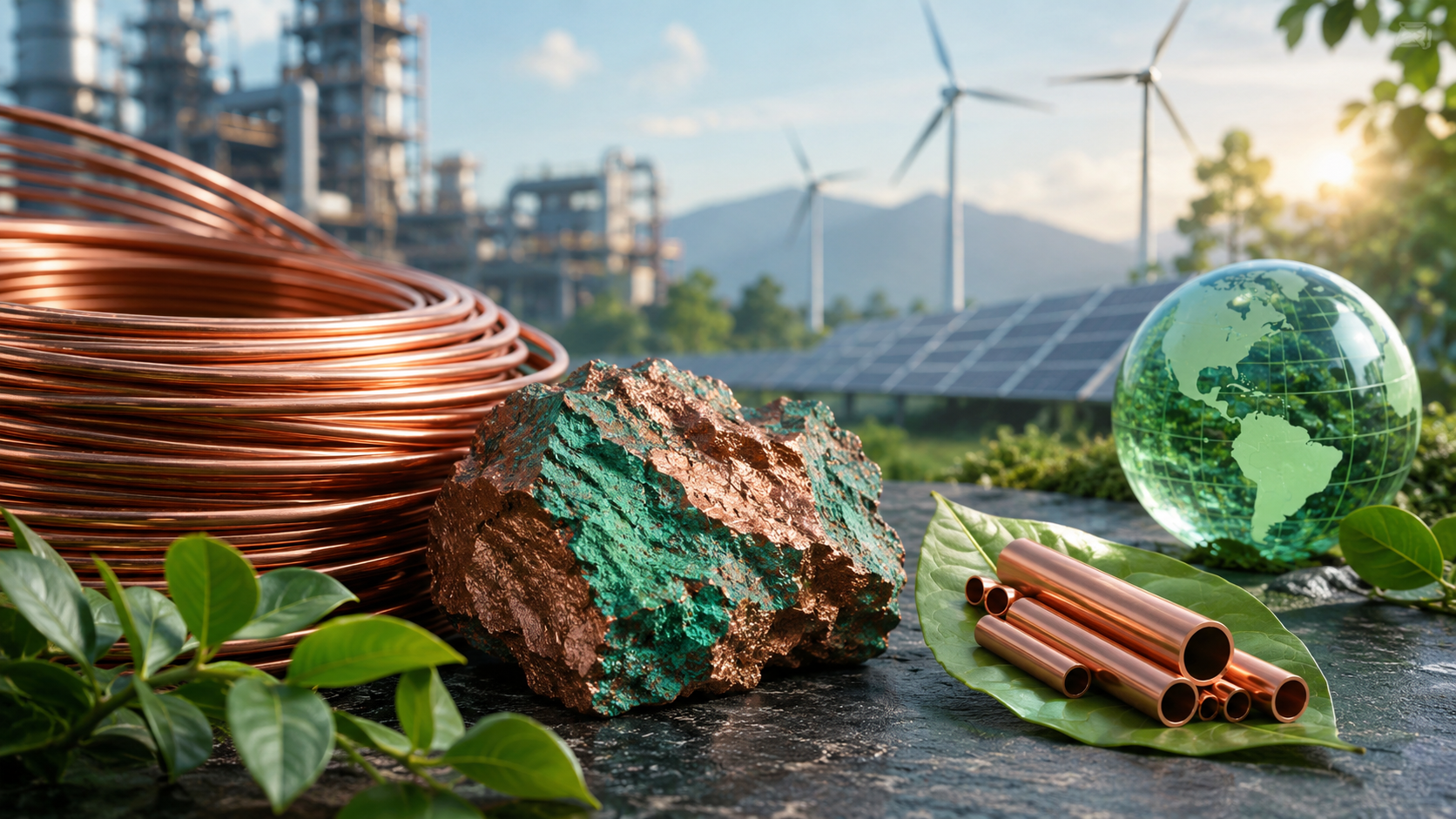
What Green Copper Is and How It Differs from Conventional Copper
Sustainability has become a strategic factor for industry, energy, construction, and mobility. In this context, more companies are seeking to understand what green copper is and why it has become one of the most relevant materials for addressing the challenges of the energy transition and industrial decarbonization.
Green copper is a concept used to describe copper produced, processed, or supplied through methods that verifiably reduce the environmental impact associated with its life cycle. Although there is no single universally accepted definition, the term generally refers to materials whose production incorporates sustainability criteria, emissions reduction, energy efficiency, traceability, and compliance with recognized environmental standards.
It is important to understand that green copper maintains exactly the same physical, chemical, and electrical properties as conventional copper. Its high electrical conductivity, mechanical strength, durability, and recyclability remain unchanged. The difference lies in how the material is sourced, processed, and distributed.
Definition of Green Copper
Green copper is copper whose supply chain incorporates measures designed to minimize environmental footprint through the use of renewable energy, more efficient production processes, carbon emissions reduction, recycling, and advanced traceability systems.
Differences Between Green Copper and Traditional Copper
- Same technical and electrical properties.
- Lower carbon footprint associated with production.
- Greater transparency regarding material origin.
- Integration of ESG and sustainability criteria.
- Stronger alignment with circular economy strategies.
- Better adaptation to future regulatory requirements.
Therefore, green copper is not a new type of copper, but a sustainable evolution of the traditional copper value chain.
How Green Copper Is Produced
Producing green copper involves applying practices designed to reduce environmental impact at every stage of the supply chain. These actions can begin with mining extraction and extend all the way to final product distribution.
Production with a Lower Carbon Footprint
One of the main goals is to reduce greenhouse gas emissions associated with production. To achieve this, producers implement more efficient technologies, electrify industrial processes, and replace fossil fuels with lower-impact energy sources.
Carbon footprint represents the total amount of emissions generated during the production, processing, and transportation of a material. Reducing it is one of the main indicators used to assess copper sustainability.
Renewable Energy and Sustainable Processes
The integration of solar, wind, or hydropower into mining and metallurgical operations can significantly reduce copper-related emissions. At the same time, industrial digitalization helps optimize energy consumption and improve resource efficiency.
According to international organizations such as the International Energy Agency, the strategic materials industry is accelerating investments in decarbonization to meet the growing demand for sustainable raw materials.
Circular Economy and Recyclability
Copper has an exceptional characteristic: it can be recycled repeatedly without losing its technical properties. This capability makes it one of the pillars of the circular economy.
The incorporation of recycled copper into verified supply chains helps reduce the need for primary extraction and lowers the environmental impact associated with the consumption of natural resources.
Benefits of Green Copper for Industry
Green copper provides environmental, economic, and strategic benefits that are driving its adoption across many industrial sectors.
Reduced Environmental Impact
The main benefit is the reduction of emissions associated with electrical, energy, and industrial projects. This enables organizations to move toward increasingly demanding sustainability goals.
Compliance with ESG Criteria
ESG criteria have become a fundamental factor for investors, customers, and regulatory bodies. Using green copper helps integrate environmental policies into corporate strategies.
- Reduced regulatory risks.
- Improved corporate positioning.
- Greater appeal to investors.
- Stronger alignment with sustainability policies.
Access to Sustainable and Competitive Markets
Many international projects include requirements related to the sustainability of the materials used. Green copper helps meet these requirements and facilitates access to markets where traceability and emissions reduction are key decision factors.
Why Green Copper Is Key to the Energy Transition
The energy transition is increasing global copper demand to unprecedented levels. Electrification of the economy requires materials capable of transmitting energy efficiently and sustainably.
This relationship can be summarized in a simple chain:
Electrification → Higher copper demand → Need for sustainable production → Expansion of green copper.
Electrification of the Economy
The gradual replacement of fossil-fuel-based technologies with electrical systems is increasing copper consumption across virtually every industrial sector.
Renewable Energy and Energy Storage
Solar farms, wind turbines, energy storage systems, and smart grids use large amounts of copper because of its excellent conductive properties.
The sustainability of these infrastructures depends not only on the energy they generate, but also on the materials used in their construction.
Electric Mobility and Smart Grids
Electric vehicles require a significantly higher amount of copper than conventional vehicles. In addition, the expansion of charging points and smart grids further increases the need for sustainable conductive materials.
Industrial Applications of Green Copper
Electrical Infrastructure
Transmission and distribution grids use green copper to improve the sustainability of systems that are essential to the modern economy.
Renewable Energy
Solar and wind installations incorporate copper in conductors, transformers, and connection systems where energy efficiency is essential.
Automotive and Electric Mobility
Transportation electrification is driving demand for sustainable copper in electric motors, batteries, and charging infrastructure.
Heavy Industry and Telecommunications
Industrial facilities, telecommunications networks, and data centers require materials that combine electrical performance, durability, and sustainability.
The same pattern appears across all these sectors:
- Need for electrification.
- Higher copper consumption.
- Sustainability requirements.
- Adoption of green copper.
How to Identify Reliable Green Copper Solutions
Framework for Identifying Green Copper
Organizations can use the following evaluation framework:
- Clearly identified origin.
- Verifiable traceability.
- Documented use of renewable energy.
- Information on associated emissions.
- Recognized environmental certifications.
- Demonstrable ESG commitments.
Sustainability Certifications and Standards
Programs such as Copper Mark, environmental management systems, and independent audits help validate the sustainability commitment of producers and distributors.
Traceability and Supply Chain Transparency
Traceability makes it possible to understand the full journey of the material from its origin to its final application. This aspect is becoming an increasingly important requirement for industrial and energy companies.
Cunext Service Solutions and Its Commitment to Green Copper
The growing demand for sustainable materials requires partners capable of delivering quality, reliability, and transparency. In this context, Cunext Service Solutions works to provide copper solutions adapted to the needs of an industry increasingly focused on sustainability.
As part of the Cunext Group, the company combines metallurgical expertise, logistics capacity, and technical knowledge to supply materials for sectors such as energy, automotive, construction, telecommunications, and heavy industry.
Its commitment to traceability, product quality, and continuous improvement allows Cunext to position itself as a benchmark in copper solutions aligned with the market’s new requirements.
Conclusion: Green Copper as a Pillar of Sustainable Industry
Understanding what green copper is means understanding how sustainability is transforming one of the most important materials for the global economy.
The combination of responsible production, emissions reduction, circular economy, and traceability makes green copper an essential element for the energy transition.
As environmental requirements increase, demand for sustainable materials will continue to grow. In this scenario, green copper is positioned as a strategic solution for building more efficient, resilient, and responsible infrastructure.
Frequently Asked Questions About Green Copper (FAQs)
It is copper produced and supplied through processes designed to reduce environmental impact and improve sustainability across the value chain.
No. It maintains the same technical properties as conventional copper. The difference lies in the sustainability of its production.
Because it helps reduce the environmental impact associated with electrical infrastructure, renewable energy, and electric mobility.
Yes. Copper retains its properties through multiple recycling cycles and is one of the materials most aligned with the circular economy.
Through certifications, traceability, environmental transparency, audits, and verifiable commitment to sustainability criteria.