
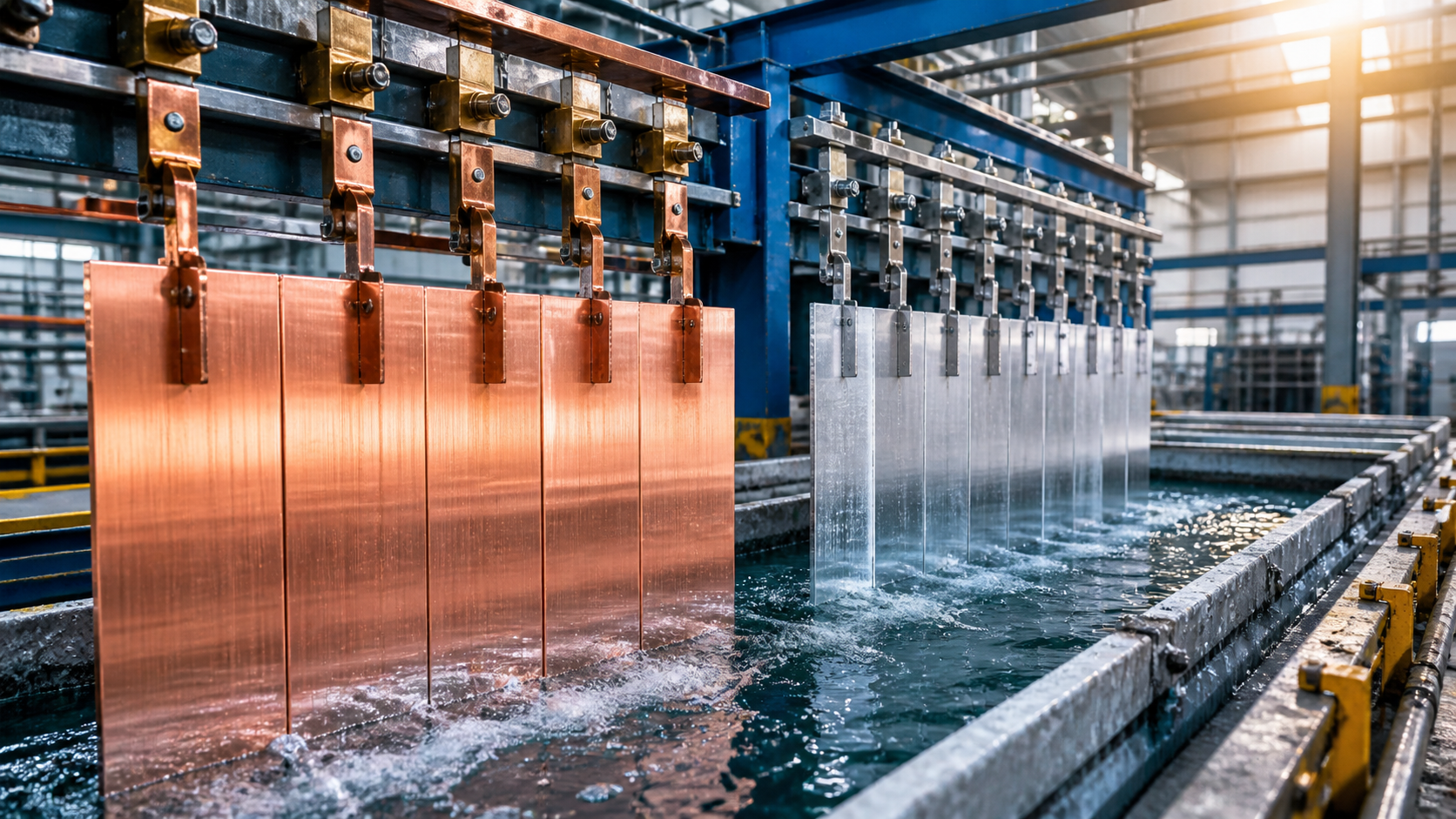
What Electrolysis Is and Its Role in Industrial Processes
Electrolysis in the copper and aluminum industry: processes and applications is a fundamental electrochemical method in modern metallurgy. It involves using electrical current to drive a non-spontaneous chemical reaction, enabling the separation of elements, removal of impurities, or production of metals from their compounds.
This process is central within the electrolysis and industrial processes cluster, as it enables the production of materials with highly controlled properties. In sectors where conductivity, purity, or structural stability are critical, electrolysis acts as a direct lever to improve overall system efficiency.
Elements of the Electrolysis Process
- Anode: electrode where oxidation occurs
- Cathode: electrode where reduction occurs
- Electrolyte: conductive medium that allows ion movement
During electrolysis, metal ions move from the anode to the cathode, depositing in pure form or separating from other elements. This mechanism underpins both copper refining and aluminum production.
Electrolysis in the Copper Industry
Copper Electrorefining Process
Copper obtained after smelting processes contains impurities such as iron, sulfur, silver, or gold. In electrorefining, this impure copper is used as the anode. When electrical current is applied, the copper dissolves into the electrolyte and is redeposited on the cathode as pure copper.
Impurities are separated during the process: some remain in solution, while others settle as anode slimes, which can later be processed to recover valuable metals.
This process achieves purity levels close to 99.99%, making it the standard for electrical and electronic applications.
Relationship Between Purity and Electrical Conductivity
The conductivity of copper is directly linked to its purity. Even small amounts of impurities can increase the material’s electrical resistance. This relationship can be summarized as follows:
- Higher purity → less electron scattering
- Less scattering → lower electrical resistance
- Lower resistance → reduced energy loss
In industrial applications, this chain of improvements translates into greater energy efficiency, particularly in power grids, motors, and transmission systems.
Applied Industrial Example
In an electrical distribution network, the use of electrolytic copper reduces losses due to the Joule effect. This results in lower heat generation, higher energy transmission efficiency, and a direct reduction in long-term operating costs.
Electrolysis in the Aluminum Industry
Hall-Héroult Process
Aluminum is not refined through electrolysis but produced directly via the Hall-Héroult process. In this process, alumina, or aluminum oxide, is dissolved in molten cryolite and subjected to electrical current. As a result, aluminum separates from oxygen and accumulates in liquid form.
This process forms the foundation of global primary aluminum production and accounts for nearly 100% of industrial aluminum output.
Energy Consumption and Process Efficiency
Aluminum electrolysis is highly energy-intensive. It typically requires between 13,000 and 15,000 kWh per ton produced. This high energy demand makes process efficiency a critical factor within the industry.
However, aluminum offers key structural advantages, such as low weight, which can partially offset its energy cost in applications like transportation and automotive engineering.
Applied Industrial Example
In the transportation sector, the use of aluminum reduces vehicle weight. This reduction leads to lower energy consumption during operation, helping offset the high initial energy cost of its production.
Comparison Between Copper and Aluminum Electrolysis
Key Process Differences
- Copper: electrolysis applied to refining
- Aluminum: electrolysis applied to primary production
- Energy consumption: moderate in copper, high in aluminum
- Objective: purity improvement vs. metal extraction
Impact on Industrial Efficiency
Both metals contribute to industrial efficiency from different perspectives:
- Copper: improves electrical efficiency through high conductivity
- Aluminum: enhances structural efficiency through weight reduction
The choice between them depends on the type of application, technical requirements, and the balance between energy cost and performance.
How Electrolysis Improves Efficiency in Industrial Processes
Efficiency Impact Framework
The relationship between electrolysis and industrial efficiency can be structured as follows:
- Controlled electrochemical process
- Production of high-purity material
- Improved physical and electrical properties
- Reduction of energy losses
- Optimization of industrial performance
Impact on Operating Costs
In industrial systems, small improvements in conductivity or efficiency can generate significant cost reductions. For example, a decrease in electrical resistance reduces heat generation, which in turn lowers cooling and maintenance requirements.
Link to Sustainability
Electrolysis also has sustainability implications. In the case of copper, recycling requires significantly less energy than primary production. For aluminum, recycling can reduce energy consumption by up to 90% compared to initial production.
Industrial Applications of Electrolytic Copper and Aluminum
Energy Sector
In power grids, transformers, and generation systems, the use of electrolytic copper and aluminum maximizes efficiency in energy transmission and distribution.
Automotive and Transportation
In electric vehicles and rail systems, these materials are essential components in automotive and transportation systems, including batteries, motors, and charging infrastructure.
Electronics and Infrastructure
Industrial electronics require high-purity materials to ensure precision and stability. Electrolysis enables these requirements to be consistently met.
Conclusion: Electrolysis as a Foundation of Industrial Efficiency
Electrolysis in the copper and aluminum industry is a key process that transforms materials into high-performance resources. In copper, its primary role is to enhance purity and conductivity. In aluminum, it enables large-scale material production.
Understanding these processes allows companies to optimize technical decisions, improve energy efficiency, and reduce operating costs. Electrolysis is not just a chemical process, but a strategic tool within modern industrial operations.
Frequently Asked Questions About Electrolysis and Industrial Processes
What is industrial electrolysis?
It is an electrochemical process that uses electrical current to drive chemical reactions in order to produce or purify materials.
What is the difference between copper and aluminum electrolysis?
In copper, it is used for refining, while in aluminum it is used to produce the metal from its compound.
Why is copper purity important?
Because it directly affects electrical conductivity and the efficiency of the systems where it is used.
What is the impact of aluminum’s energy consumption?
It is high during production, but can be offset in applications where reduced weight improves efficiency.
Which industries use industrial electrolysis?
Mainly energy, automotive, transportation, electronics, and heavy industry.