
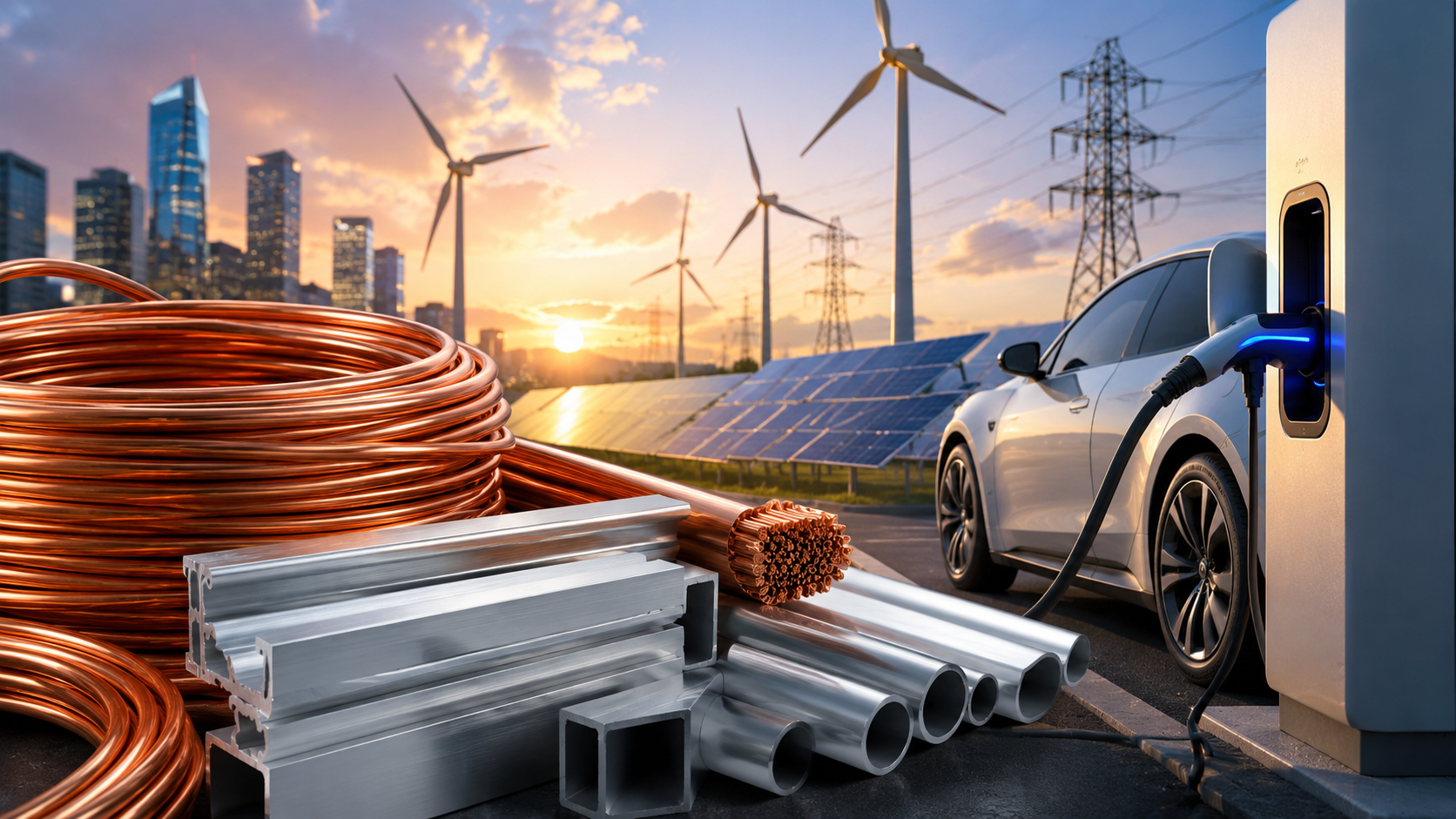
What Global Electrification Is and Why It Is Transforming Industry
Global electrification is the process by which activities traditionally dependent on fossil fuels shift to electricity as their primary energy source. This phenomenon affects sectors such as transportation, industry, construction, telecommunications, and power generation.
Electrification is one of the pillars of the global energy transition. Its goal is to improve the efficiency of production systems, reduce greenhouse gas emissions, and support the integration of renewable energy.
However, electrification cannot develop without infrastructure capable of generating, transmitting, distributing, and storing electricity. For this reason, the impact of global electrification on industrial copper and aluminum demand has become one of the most relevant trends for manufacturers, distributors, and consumers of conductive materials.
The Causal Chain Driving Demand for Conductive Metals
The relationship between electrification and material demand can be summarized through a simple sequence:
Electrification → Higher electricity consumption → Expansion of energy infrastructure → Need for conductors → Increased demand for copper and aluminum.
Understanding this chain makes it possible to anticipate market changes and plan more resilient supply strategies.
Why Electrification Increases Demand for Copper and Aluminum
Electricity requires materials capable of carrying current efficiently, safely, and durably. The higher the level of electrification in an economy, the greater the need for conductive materials.
The Importance of Conductive Materials
Copper and aluminum are the two most widely used materials for transmitting electrical energy at industrial scale.
Both are used in:
- Transmission networks.
- Distribution networks.
- Transformers.
- Substations.
- Electric motors.
- Data centers.
- Energy storage systems.
- Telecommunications infrastructure.
Without these materials, it would be impossible to develop the infrastructure needed to support an electrified economy.
More Extensive and Complex Electrical Infrastructure
The expansion of renewable energy, electric vehicles, and smart systems requires larger and more sophisticated grids. Every new power line, transformer, charging station, or storage system increases the need for copper and aluminum.
According to organizations such as the International Energy Agency, the energy transition will require a significant increase in grid investment over the coming decades.
The Strategic Role of Copper in Global Electrification
Copper is considered one of the most important materials for electrification due to its combination of conductivity, mechanical strength, and reliability.
Why Copper Is Essential
Copper’s high electrical conductivity helps reduce energy losses and optimize the performance of electrical systems.
For this reason, it is widely used in:
- Transformers.
- Electric motors.
- Power cables.
- Electrical panels.
- Automation systems.
- Industrial electronics.
In applications where energy efficiency and reliability are priorities, copper remains the benchmark solution.
Copper and the Energy Transition
The expansion of electric mobility, renewable energy, and energy storage systems is increasing global copper demand.
An electric vehicle can require several times more copper than a conventional vehicle because of its motors, inverters, batteries, and associated electronic systems.
Similarly, solar and wind farms incorporate large amounts of copper in conductors, transformers, and connection systems.
The Strategic Role of Aluminum in Global Electrification
Aluminum plays a complementary role to copper and is essential for the development of large-scale electrical infrastructure.
Technical Advantages of Aluminum
Its main feature is the combination of good electrical conductivity with a significantly lower weight than copper.
- Lower density.
- High corrosion resistance.
- Ease of transportation and installation.
- Excellent cost-performance ratio.
These advantages make it an especially efficient option for applications where weight is a determining factor.
Applications of Aluminum in Electrification
Aluminum is widely used in:
- Overhead conductors.
- Transmission networks.
- Energy infrastructure.
- Sustainable mobility.
- Railway industry.
- Automotive industry.
Its role will continue to grow as the need for more extensive and efficient electrical grids increases.
Comparison Between Copper and Aluminum in Electrical Applications
Global electrification does not mean choosing between copper and aluminum. Both materials are complementary and respond to different needs.
Key Technical Differences
- Copper: maximum electrical conductivity.
- Copper: high mechanical strength.
- Aluminum: lower weight.
- Aluminum: excellent economic performance in large infrastructure projects.
- Copper: ideal for compact applications.
- Aluminum: especially efficient over long distances.
When to Use Each Material
Selection depends on:
- Required current-carrying capacity.
- Weight limitations.
- Environmental conditions.
- Total cost of ownership.
- Expected service life.
- Maintenance requirements.
The right combination of both materials helps optimize the technical and economic performance of projects.
The Sectors Driving the Highest Demand for Copper and Aluminum
Renewable Energy
The expansion of solar and wind farms is generating growing demand for electrical conductors and associated components.
Electric Mobility
Electric vehicles, electrified buses, rail systems, and charging stations require increasing amounts of copper and aluminum.
Data Centers and Telecommunications
Global digitalization and the growth of artificial intelligence are driving new investment in data centers with high energy requirements.
Industry and Automation
Industrial automation increases the use of motors, sensors, converters, and advanced electrical systems.
Energy Storage
Batteries and storage systems are essential to stabilizing renewable grids and represent a new demand driver for conductive materials.
Industrial Challenges Driven by Rising Demand
Supply Security
Growth in global consumption is increasing pressure on conductive metal supply chains.
Companies must manage risks related to availability, lead times, and price volatility.
Sustainability and Traceability
Demand for sustainable and traceable materials is growing in parallel with electrification.
Industrial projects are increasingly seeking solutions capable of combining technical performance with environmental goals.
Framework for Preparing for Demand Growth
Organizations can reduce risk through a structured approach:
- Monitor electrification trends.
- Analyze sector demand forecasts.
- Diversify supply sources.
- Assess availability risks.
- Prioritize certified and traceable materials.
- Plan long-term strategic purchasing.
This framework helps transform a global trend into a sustainable competitive advantage.
How Cunext Service Solutions Can Help
Copper and Aluminum Solutions for Strategic Sectors
Cunext Service Solutions supplies copper and aluminum solutions for sectors leading global electrification, including energy, automotive, telecommunications, construction, and industry.
Reliability, Quality, and Supply Continuity
As part of the Cunext Group, the company combines metallurgical expertise, technical knowledge, and logistics capacity to help customers address the challenges associated with growing demand for conductive materials.
Quality, traceability, and supply reliability help reduce risks and ensure continuity in strategic industrial projects.
Conclusion: A Structural Trend That Will Redefine the Conductive Metals Market
Global electrification is a long-term structural transformation that is profoundly changing demand for copper and aluminum.
The expansion of renewable energy, electric mobility, digitalization, and industrial automation will continue to drive consumption of conductive materials over the coming decades.
Understanding this evolution allows manufacturers, distributors, and industrial companies to anticipate risks, secure supply, and capture new growth opportunities in an increasingly electrified market.
Frequently Asked Questions About Electrification, Copper, and Aluminum (FAQs)
It is the process of replacing fossil-fuel-based technologies with systems powered by electricity.
Because copper is essential for power grids, motors, transformers, and renewable energy systems.
Its low weight and good conductivity make it an efficient solution for large-scale networks.
Renewable energy, electric mobility, data centers, telecommunications, and automated industry.
Through strategic planning, supplier diversification, and collaboration with specialized partners such as Cunext Service Solutions.