
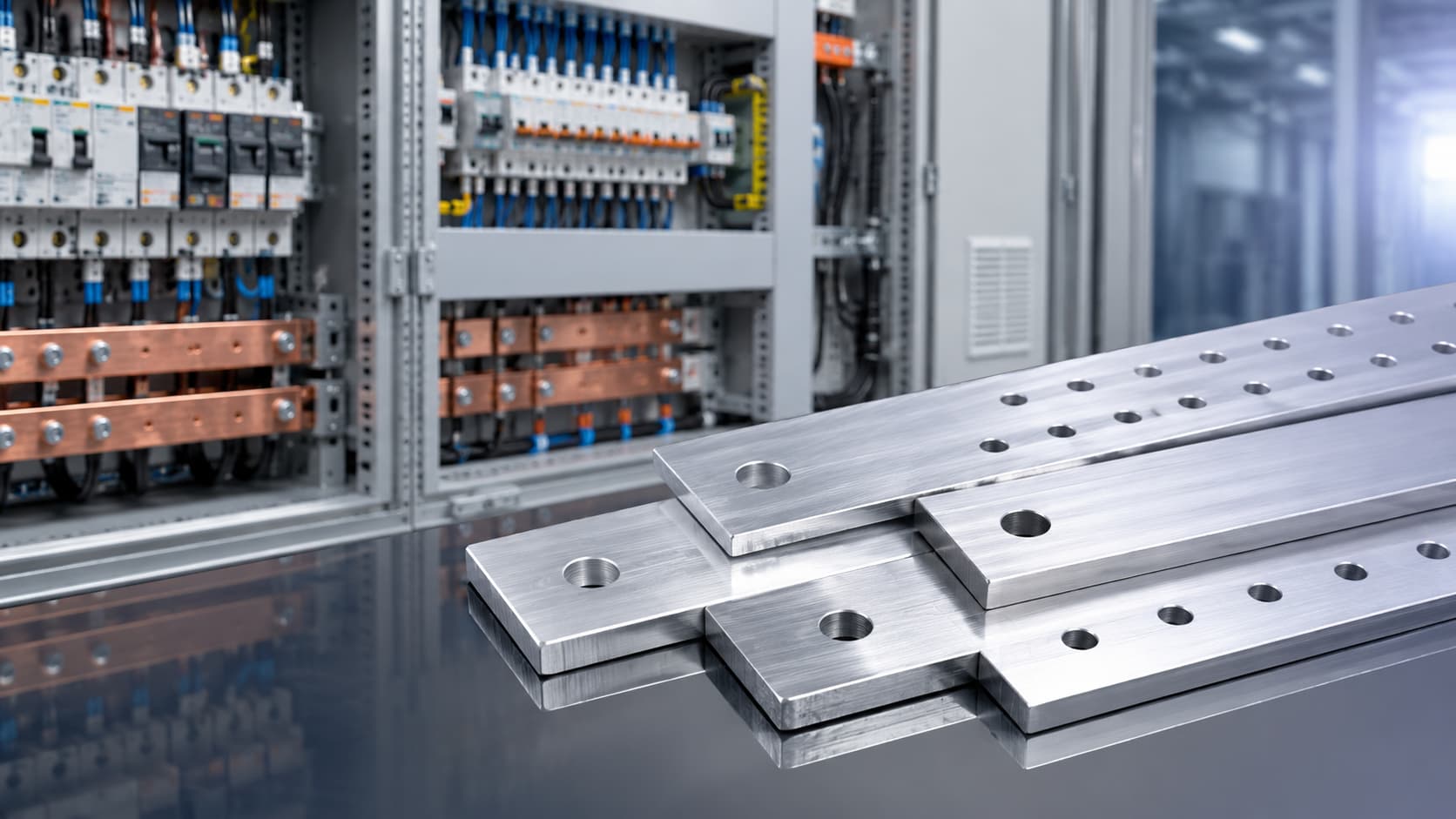
What Copper Busbars Are and Their Function in an Electrical Panel
Copper busbars for power electrical panels are conductive elements designed to distribute electrical current safely, efficiently, and reliably within industrial installations. They are also known as bus bars, conductive bars, or electrical busbar systems, and are used to connect switches, protection devices, transformers, disconnectors, and other equipment inside the panel.
Their function is to create a robust conductive path capable of carrying high current loads with low electrical losses. In power panels, where service continuity and safety are critical, copper remains one of the benchmark materials thanks to its high electrical conductivity, thermal performance, and mechanical strength.
Unlike other materials, copper enables more compact system designs because it requires a smaller cross-section to carry the same current. This does not mean it always reduces total weight compared to aluminum, but it can reduce the volume of the busbar system, optimize available space, and improve the power density of the electrical panel.
Technical Definition of a Copper Conductive Busbar
A copper busbar is a solid metal conductor, usually with a rectangular cross-section, manufactured to carry electrical current within power distribution systems. Its geometry facilitates mechanical connection, improves contact surface area, and supports heat dissipation during operation.
Function Within a Power Electrical Panel
Inside an electrical panel, busbars act as the main axis of power distribution. They help organize current flow between circuits, reduce wiring complexity, and improve accessibility for inspection and maintenance.
They also help improve thermal behavior control within the system, provided the design accounts for rated current, ventilation, ambient temperature, phase spacing, and expected short-circuit conditions.
Technical Properties of Copper for Electrical Applications
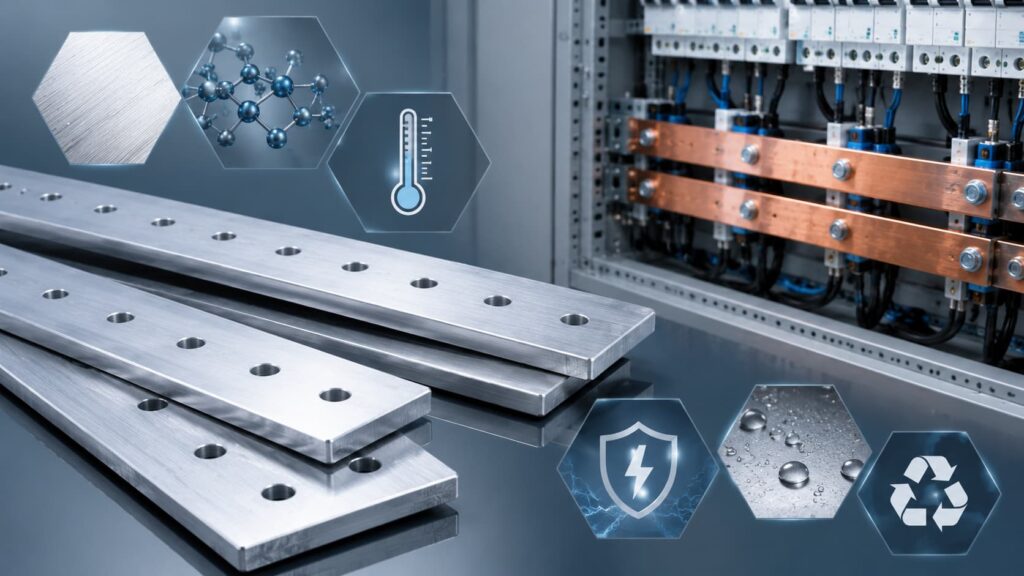
Copper is one of the most widely used materials in industrial electrical conductors due to its combination of conductivity, thermal stability, mechanical strength, and durability. These properties make it especially suitable for electrical panels exposed to high loads and continuous operation.
Electrical Conductivity and Energy Efficiency
The main advantage of copper is its high electrical conductivity. High-purity annealed copper is used as the reference for the IACS standard, which is used to compare the conductivity of other conductive materials.
Higher conductivity means lower electrical resistance. This lower resistance helps reduce Joule effect losses, limit heat generation, and improve the overall energy efficiency of the electrical panel.
- Higher electrical conductivity.
- Lower conductor resistance.
- Reduced energy losses.
- Lower heat generation.
- Greater operational efficiency.
Thermal Conductivity and Heat Dissipation
Copper’s thermal conductivity facilitates the evacuation of heat generated during current flow. This property is especially important in busbar systems exposed to high current loads, where poor thermal management can cause overheating, insulation degradation, or reduced equipment lifespan.
System design must consider the busbar cross-section, spacing between conductors, panel ventilation, ambient temperature, and possible heat buildup at connection points.
Mechanical Strength and Short-Circuit Stability
Copper busbars must withstand mechanical stresses from assembly, vibration, and electrodynamic forces that occur during a short circuit. These forces can be very high and may affect busbar system stability if the system is not properly sized.
For this reason, the design must account not only for continuous service current, but also for maximum short-circuit current, mechanical fastening, support rigidity, and spacing between bars.
Durability and Contact Resistance
The performance of a busbar does not depend only on the base material. Electrical joints are also critical. High contact resistance can generate hot spots, energy losses, and premature system deterioration.
To avoid this, it is important to control surface quality, tightening torque, material finish, and compatibility between components. In certain environments, tin-plated copper can improve connection performance and provide additional protection against oxidation.
Advantages of Copper Busbars for Power Electrical Panels
Copper busbars offer important advantages when a project requires high conductivity, reliability, compactness, and long-term stability. Their value should be assessed by considering total cost of ownership, not only the initial material cost.
Higher Power Density in Less Space
Thanks to its high conductivity, copper can carry high current loads with more compact cross-sections. This is especially useful in electrical panels where internal space is limited or where the goal is to increase distribution capacity without increasing the overall system size.
Reduced Electrical Losses
Lower electrical resistance reduces energy losses throughout the entire service life of the installation. In continuously operating panels, this improvement can directly impact energy efficiency, thermal stability, and reduced cooling requirements.
Reliability in Critical Applications
Copper busbars are especially suitable for installations where service continuity is essential, such as data centers, industrial plants, energy infrastructure, hospitals, transformer substations, and electric mobility systems.
Total Cost of Ownership Optimization
Although copper may have a higher initial cost than aluminum, its high conductivity, lower loss generation, durability, and ability to support compact system designs can improve total cost of ownership in demanding applications.
Copper Busbars vs. Aluminum Busbars
The comparison between copper and aluminum should be made based on the specific needs of each project. Both materials play a fundamental role in industrial electrical distribution, but they have different characteristics that determine their application.
Technical Comparison Between Copper and Aluminum
- Electrical conductivity: copper offers higher conductivity, allowing the same current to be carried with a smaller cross-section.
- Weight: aluminum has a lower density, making it the best option when weight reduction is a priority.
- Compactness: copper enables more compact busbar systems thanks to its high conductivity.
- Mechanical strength: copper better withstands mechanical stresses and electrodynamic forces caused by short circuits.
- Heat dissipation: copper’s high thermal conductivity supports more efficient heat evacuation.
- Initial cost: aluminum usually offers a lower cost per kilogram, while copper can provide advantages in efficiency and service life.
- Life cycle cost: in installations exposed to continuous operation, copper’s lower electrical losses can offset the higher initial investment.
When Should You Choose Copper Busbars?
Copper busbars are usually the most suitable solution when:
- The installation has limited available space.
- Very high current loads must be carried.
- Energy efficiency is a priority objective.
- Power supply continuity is critical.
- The goal is to minimize electrical losses throughout the entire service life.
- There are high requirements for mechanical stress and short-circuit resistance.
When Should You Choose Aluminum?
Aluminum busbars are an excellent alternative when:
- Reducing installation weight is a determining factor.
- There are long electrical runs.
- The initial material cost plays an important role in the project.
- The panel dimensions allow larger cross-sections to be used.
The final decision should always be based on a complete technical analysis that considers operating conditions, regulatory requirements, and the total project cost.
Industrial Applications of Copper Busbars
Copper’s high performance means it remains the benchmark material in many sectors where electrical safety and service continuity are essential.
Main Low-Voltage Switchboards
Main switchboards use copper bars to distribute energy across multiple circuits with a high level of safety, stability, and current-carrying capacity.
Transformer Substations
Busbars make it possible to connect transformers, circuit breakers, switchgear, and protection systems, ensuring reliable distribution even under high energy demand conditions.
Data Centers
Data centers require electrical systems capable of uninterrupted operation. Copper busbars help minimize energy losses and improve the thermal stability of the installation.
Renewable Energy
Solar PV installations, wind farms, and energy storage systems use copper busbar systems in inverters, distribution panels, and transformer substations to maximize electrical transmission efficiency.
Electric Mobility
Fast-charging infrastructure, electric vehicle manufacturers, the railway industry, and electrified transportation systems use copper busbars because of their ability to withstand high current loads with strong reliability.
Heavy Industry
Steelmaking, mining, the chemical industry, machinery manufacturing, and other industrial environments use high-power electrical panels where the robustness and safety of busbar systems are decisive for ensuring operational continuity.
How to Select the Right Copper Busbar
Conductor selection should not be based only on rated current. Proper sizing must consider all electrical, thermal, and mechanical factors that affect installation performance.
Framework for Selecting a Copper Busbar
- Determine the rated service current.
- Calculate the maximum short-circuit current.
- Correctly size the conductor cross-section.
- Evaluate the allowable voltage drop.
- Analyze heat dissipation capacity.
- Consider ambient temperature and panel ventilation.
- Verify expected mechanical stresses.
- Correctly design electrical joints to minimize contact resistance.
- Check coordination with protection devices.
- Plan future installation expansions.
- Verify compliance with applicable standards.
- Define a preventive maintenance plan.
This procedure helps optimize busbar system performance, increase electrical safety, and reduce the risk of overheating or premature failure.
Applicable Regulations and Standards
Industrial electrical installations must be designed according to international standards that ensure system safety, quality, and reliability.
The main technical references include:
- IEC 61439, covering low-voltage switchgear and controlgear assemblies and electrical panels.
- IEC 60947, applicable to switching and protection devices.
- IEC 60204, covering the safety of electrical equipment of machines.
- Specific standards related to thermal testing, short-circuit resistance, and mechanical behavior of busbar systems.
Beyond regulatory compliance, it is essential to work with materials whose composition, purity, and traceability are controlled to ensure consistent behavior throughout the installation’s service life.
How Cunext Service Solutions Can Help
Cunext Service Solutions supplies high-quality copper solutions for industrial projects where electrical safety, energy efficiency, and power supply continuity are critical factors.
As part of the Cunext Group, the company combines metallurgical expertise, production capacity, quality control, and technical knowledge to offer materials adapted to the needs of electrical panel manufacturers, engineering firms, installers, and industrial companies.
Material traceability, compliance with international standards, and a strong supply chain make it possible to approach highly complex projects with greater technical assurance.
Thanks to its experience in copper and aluminum, Cunext Service Solutions can advise on the most suitable conductor selection based on the electrical, mechanical, and economic requirements of each application.
Conclusion: Copper Remains the Benchmark for Power Electrical Panels
Copper busbars for power electrical panels continue to be one of the most efficient solutions for industrial electrical distribution when high performance, maximum reliability, and safe long-term operation are required.
Their high electrical conductivity, excellent thermal behavior, mechanical strength, and ability to support compact system designs help optimize the performance of electrical panels used in critical infrastructure, heavy industry, renewable energy, and electric mobility.
Correct selection of the conductor cross-section, compliance with international standards, and the use of high-quality materials are essential factors for ensuring safety, reducing energy losses, and maximizing installation service life.
Working with a specialized supplier such as Cunext Service Solutions provides access to copper solutions with high quality standards, specialized technical support, and extensive experience in industrial electrical distribution applications.
Frequently Asked Questions About Copper Busbars for Electrical Panels (FAQs)
It is a rectangular-section metal conductor used to distribute electrical current between the different pieces of equipment that make up a power electrical panel.
Copper provides higher electrical and thermal conductivity, greater mechanical strength, and enables more compact busbar system designs when available space is limited.
Sizing must consider rated current, short-circuit current, operating temperature, voltage drop, heat dissipation, environmental conditions, and applicable standards.
The most relevant standards are IEC 61439 for low-voltage electrical panels, IEC 60947 for switching and protection devices, and IEC 60204 for electrical equipment of machines.
They are used in industrial electrical panels, transformer substations, renewable energy, data centers, electric mobility, the railway industry, industrial automation, and critical infrastructure where reliable power supply is essential.