
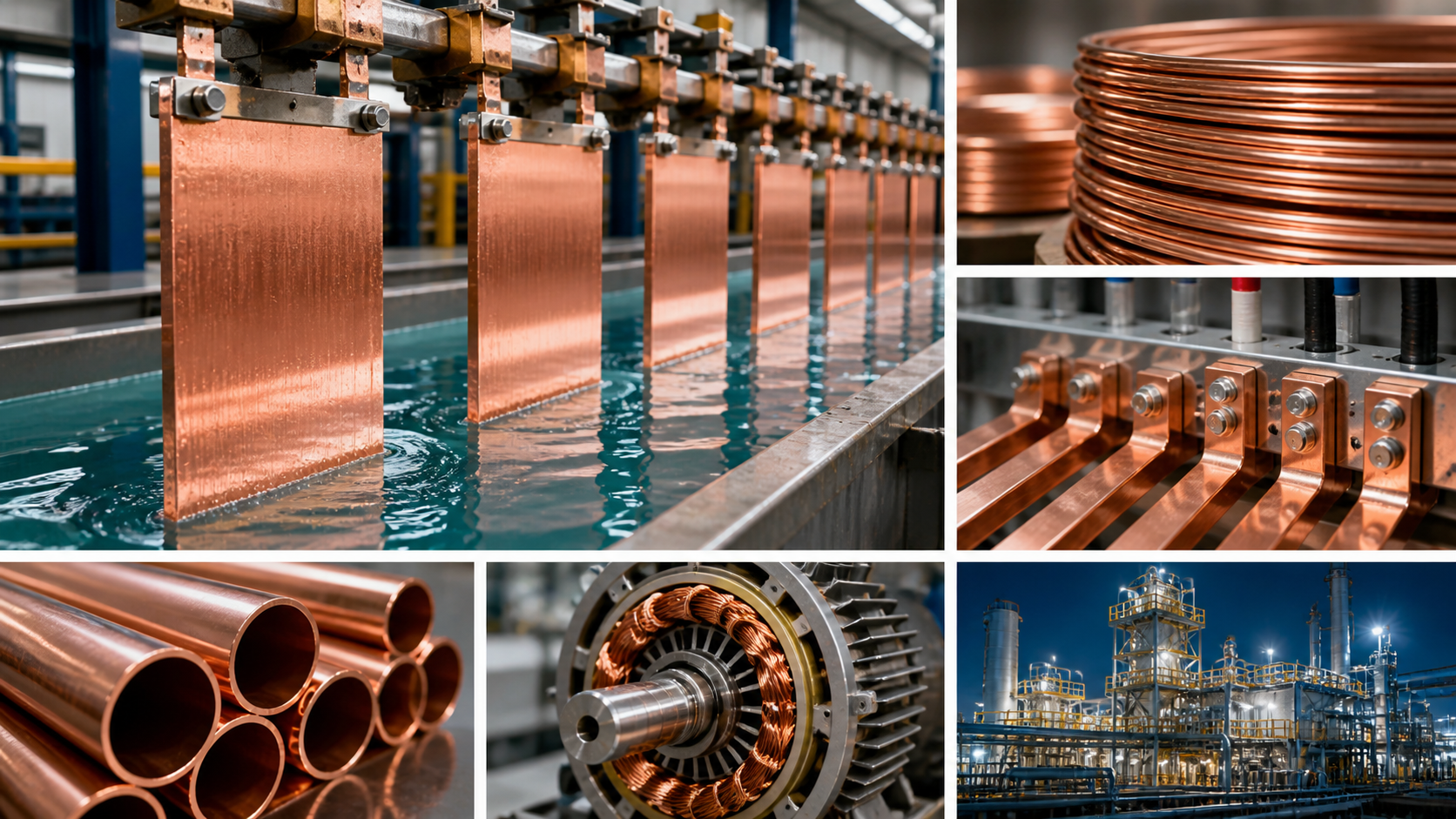
What Electrorefining Is and the Role of Electrolysis in Industrial Copper
The role of electrolysis in industrial refined copper production is critical within modern metallurgical processes. This method transforms impure copper into a highly efficient material suitable for electrical applications where conductivity and stability are essential.
Electrolysis applied to copper, known as electrorefining, is based on a simple electrochemical principle: by applying electrical current, impure copper dissolves and is redeposited in pure form. This process enables precise control over material quality, making it a standard in industrial copper processing.
Operational Definition of Electrorefining
Electrorefining is a process in which impure copper (anode) dissolves into an electrolyte and is deposited as pure copper onto the cathode through the application of direct current.
Key Elements of the Process
- Anode: impure copper from smelting (≈98–99%)
- Cathode: sheet where refined copper is deposited
- Electrolyte: aqueous solution of copper sulfate and sulfuric acid
This system efficiently separates copper from other elements, ensuring a consistent and controlled composition.
Stages of Refined Copper Production
From Blister Copper to Electrolytic Copper
The process begins with blister copper, obtained after ore smelting. This material contains between 98% and 99% copper, along with impurities such as iron, sulfur, nickel, or precious metals. Although relatively pure, it is not sufficient for advanced electrical applications.
To enhance its properties, blister copper undergoes electrolysis, transforming it into high-purity electrolytic copper.
Step-by-Step Electrorefining Process
- Casting blister copper into anodes
- Installing anodes and cathodes in electrolytic cells
- Applying controlled direct current
- Dissolution of copper from the anode into the electrolyte
- Deposition of pure copper onto the cathode
This continuous and controlled process produces copper with purity levels close to 99.99%, corresponding to conductivity values near 100% IACS.
Process Byproducts: Anode Slimes
During electrolysis, impurities that do not dissolve in the electrolyte accumulate at the bottom of the cell, forming anode slimes. These residues contain valuable metals such as gold, silver, or platinum.
Recovering these byproducts adds economic value, making electrorefining not only a technical process but also a strategically important one.
Copper Purity and Its Impact on Electrical Performance
Purity Levels and Industry Standards
Electrolytic copper reaches purity levels of approximately 99.99%, making it the benchmark material for electrical applications. This level of purity ensures stable electrical performance and minimizes variability.
Technical Relationship Between Purity and Conductivity
The electrical conductivity of copper is directly dependent on its purity. Even trace impurities can disrupt electron flow and increase electrical resistance.
- Higher purity → less electron scattering
- Less scattering → lower resistance
- Lower resistance → reduced energy loss
- Reduced loss → higher system efficiency
This behavior makes refined copper a key material for optimizing energy efficiency in electrical and industrial systems.
How Electrolysis Improves Efficiency in Industrial Applications
Efficiency Impact Framework
- Controlled electrochemical process
- Production of high-purity copper
- Optimization of electrical properties
- Reduction of Joule effect losses
- Improved overall energy performance
Technical Example in Power Grids
In electrical distribution systems, even a slight reduction in conductor resistance can generate significant cumulative energy savings. This results in lower heat generation, reduced material wear, and improved transmission efficiency.
Example in Electric Motors
In industrial motors, the use of refined copper reduces internal losses and improves system efficiency. This directly impacts energy consumption and extends equipment lifespan.
Applications of Refined Copper in Industry
Energy Sector
Refined copper is essential in transmission and distribution networks, transformers, and power generation systems. Its high conductivity maximizes energy transport efficiency.
Automotive and Transportation
In electric mobility, refined copper is used in motors, batteries, and charging systems. It is a key material in automotive and transportation components, where energy efficiency is critical.
Electronics and Infrastructure
Industrial electronics require high-purity materials to ensure precision, stability, and durability. Electrolytic copper consistently meets these requirements in complex systems.
Comparison: Refined vs. Unrefined Copper
Key Technical Differences
- Purity: 99.99% vs. lower
- Conductivity: high vs. reduced
- Energy losses: low vs. higher
- Applications: electrical vs. limited use
Impact on Industrial Performance
Using refined copper improves energy efficiency, reduces losses, and increases system durability. At scale, these improvements can lead to significant reductions in operating costs.
Conclusion: Electrorefining as the Foundation of Modern Industrial Copper
The role of electrolysis in industrial refined copper production is a key process that transforms impure copper into a high-performance material. Through electrorefining, copper reaches purity levels that optimize its electrical behavior and enhance industrial system efficiency.
Understanding the relationship between process, purity, and performance enables companies to optimize technical decisions, improve energy efficiency, and strengthen their competitiveness in the industrial market.
Frequently Asked Questions About Electrolysis and Refined Copper
What is copper electrorefining?
It is an electrochemical process that uses electrical current to purify copper to high levels of purity.
Why is copper purity important?
Because it directly affects electrical conductivity and the efficiency of the systems where it is used.
What is the difference between blister copper and refined copper?
Blister copper contains impurities, while refined copper has been purified through electrolysis.
What are anode slimes?
They are byproducts of the electrolysis process that contain impurities and recoverable valuable metals.
Where is refined copper used?
It is used in sectors such as energy, automotive, transportation, and industrial electronics.