
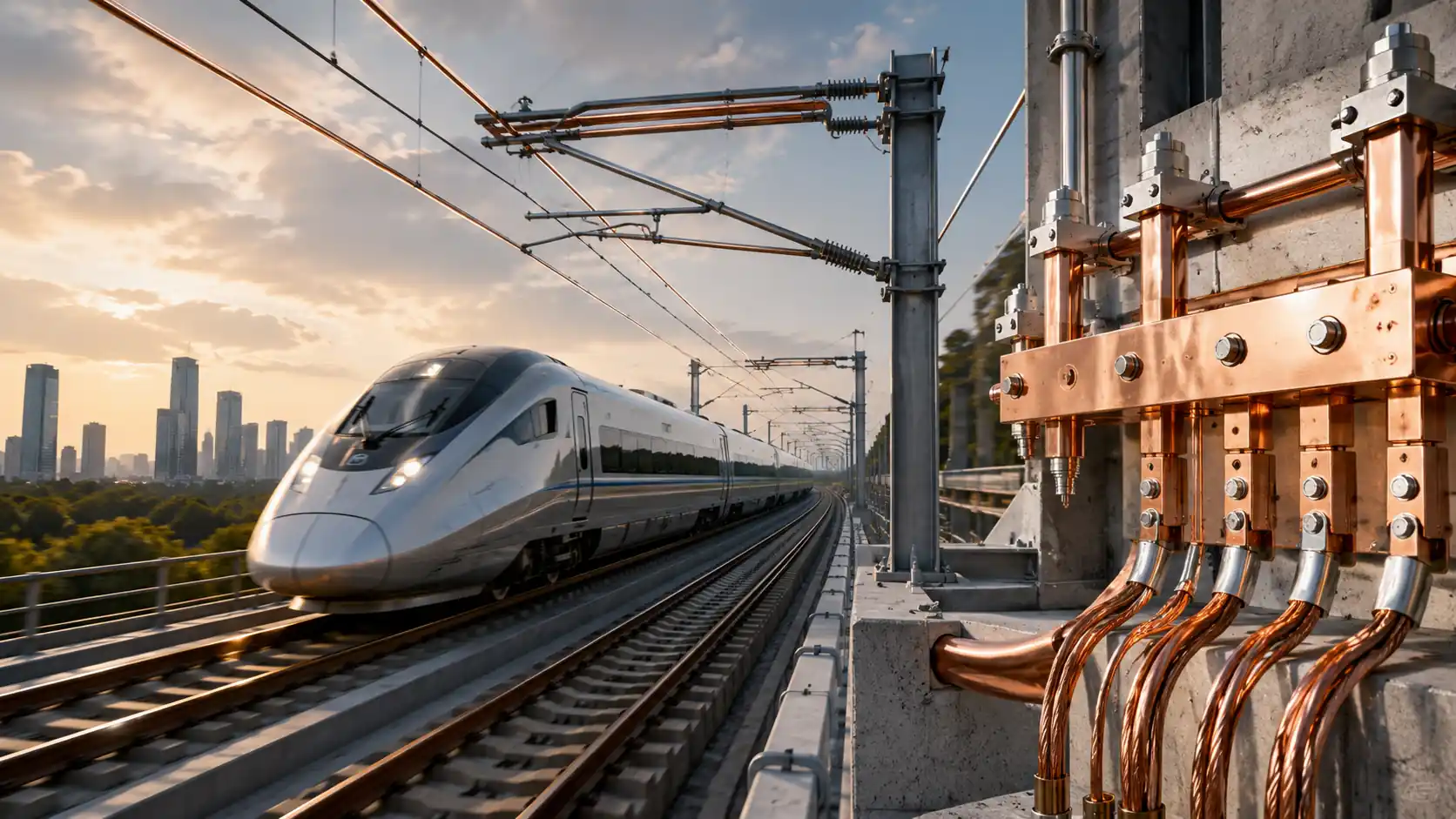
Copper solutions for railway infrastructure are used in systems that must ensure service continuity, safety, and stability over long periods. In electrified railway infrastructure, copper is present in the components responsible for transferring power from the traction network to the train, particularly within the catenary or Overhead Catenary System (OCS).
The catenary enables continuous current collection through permanent contact between the pantograph and the contact wire. To maintain a safe and efficient power supply over many years of operation, the system must withstand millions of contact cycles, temperature fluctuations, mechanical stresses, vibrations, and demanding environmental conditions. For this reason, there is no single copper grade suitable for every component: each application requires a specific balance of electrical conductivity, mechanical strength, durability, and traceability.
Material selection must take into account function, operating conditions, properties, standards, and documentation. For its conventional rail network, Adif reports 9,200 kilometers of overhead contact lines, 341 electrical substations, and 1,844,000 kW of installed power. These figures illustrate the technical and operational scale of railway electrification and the importance of selecting materials capable of maintaining performance throughout their entire life cycle.
Where Copper Is Used in Railway Infrastructure
The catenary or Overhead Catenary System is the electrification system responsible for transferring electrical power to the train. To ensure continuous, safe, and efficient current collection, it combines different components that work together. All of them may incorporate copper or copper alloys, but each performs a different function and therefore requires specific properties.
- Contact wire: transfers electrical current to the pantograph and withstands wear, mechanical tension, and heating.
- Messenger wire: supports the contact wire and helps maintain the geometry of the catenary system.
- Feeder conductors: reinforce the electrical supply and help reduce voltage drops.
- Droppers: connect the messenger wire to the contact wire to maintain its height and position.
- Return circuit: carries current back to the electrical substation.
- Bars and busbars: distribute power in substations, connections, and traction-related equipment.
This distinction is important because the catenary should not be confused with the contact wire. The catenary is the complete system, while the contact wire is one of its most critical components.
Why Copper Is the Benchmark Material for Catenary Systems
Copper has become the benchmark material for catenary systems because it combines high electrical conductivity, strong mechanical performance, reliable wear behavior, and long-term durability. These properties help maintain efficient current collection even on high-speed lines, under high current loads, and through millions of contact cycles between the pantograph and the conductor.
In practice, its value does not depend on a single isolated property. Copper is particularly useful because it combines electrical conduction, functional stability, and long-term reliability. Depending on project requirements, different copper grades or alloys may also be used to optimize the balance between efficiency, strength, and service life.
Properties of High-Performance Railway Copper
Electrical conductivity is an essential criterion, but it is not the only one. The performance of a railway system depends on the material’s ability to withstand the operating environment and maintain stable behavior over time.
- Electrical conductivity: reduces energy losses, limits heating, and improves the efficiency of the electrification system.
- Mechanical strength: enables the material to withstand tensile forces and helps preserve catenary tension and geometry.
- Wear resistance: is especially important for the contact wire, which is exposed to continuous friction from the pantograph.
- Thermal stability: helps maintain performance under temperature changes and load cycles.
- Dimensional accuracy: dimensions and tolerances must meet specifications to ensure compatibility with clamps, connections, and other system components.
These properties must be evaluated together. Improving one property may affect another. For example, a specific alloy may increase mechanical strength or hardness while slightly modifying conductivity. On heavily trafficked corridors or high-speed lines, this balance becomes even more important to ensure stable interaction between the pantograph and the catenary system.
High-Conductivity Copper or Copper Alloys
Material selection depends on the function of each component. Some applications prioritize maximum electrical conductivity to minimize losses. Others require greater mechanical strength, improved wear performance, or enhanced thermal stability.
Common solutions include high-conductivity copper (Cu-ETP), copper-silver (CuAg), and copper-magnesium (CuMg), selected in accordance with the applicable Technical Specifications for Interoperability (TSIs). Each option provides a different balance of electrical conductivity, mechanical strength, hardness, and durability. The decision must therefore always consider service conditions, line speed, mechanical loads, catenary design, and project specifications.
No option is universally superior. The correct choice is the one that best meets the function of the component and the actual conditions of the infrastructure.
Standards for Railway Copper Solutions
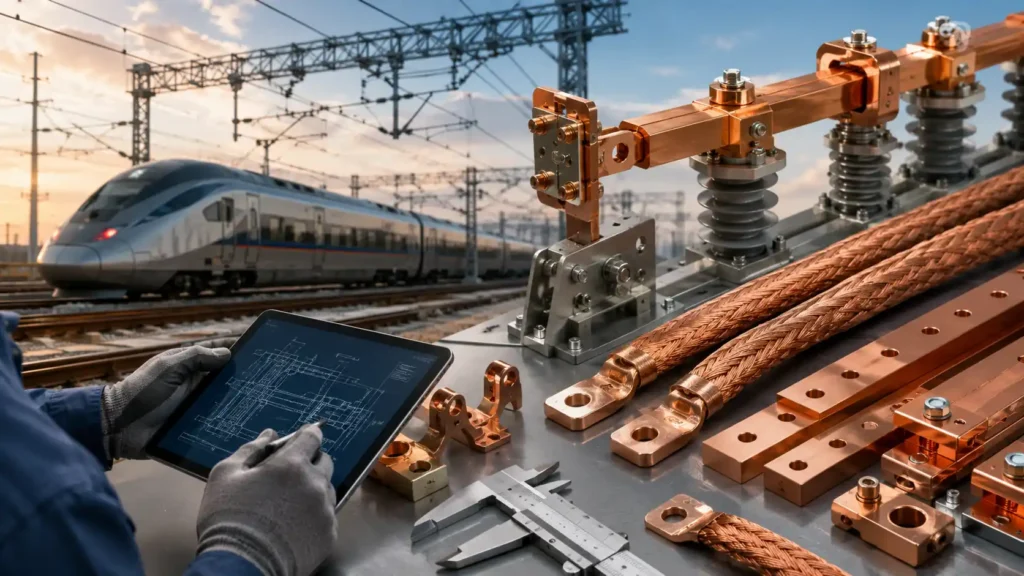
The Technical Specifications for Interoperability (TSIs) establish technical and operational requirements for railway subsystems within the European Union. In particular, the Energy TSI regulates the fixed installations used to supply traction power. This framework must be complemented by product standards, infrastructure manager specifications, and the specific requirements of each project.
- EN 50119: overhead contact lines for electric traction.
- EN 50149: grooved contact wires made of copper and copper alloys.
- EN 50367: interaction between the pantograph and the overhead contact line.
- EN 50122: electrical safety, grounding, and return circuits.
- EN 50163 and IEC 60850: railway supply voltages.
The current edition, scope, and specific application to the project must always be verified. A standard defines requirements or methods, but it does not by itself demonstrate the conformity of the supplied material.
Testing, Certificates, and Traceability
Technical documentation is essential for verifying the conformity of railway products. The technical data sheet describes the product; the quality certificate records the characteristics of the supplied material; testing provides verifiable results; and traceability links all this information to a specific batch, heat, or production lot.
Documentation may include chemical composition, electrical conductivity, mechanical strength, hardness, dimensions, tolerances, and, when applicable, the approvals or validations required by the project. This traceability facilitates material acceptance, audits, incident management, and future replacement orders.
In a railway environment, documentary evidence is not an optional addition. It is the basis for confirming that the proposed or supplied solution actually meets the required technical specification.
Durability and Life Cycle Cost
The initial cost represents only part of the investment. In a catenary system, the contact wire is exposed to continuous wear caused by pantograph contact, current intensity, operating speed, line geometry, environmental conditions, and maintenance activities.
For this reason, the evaluation of a solution should also consider expected service life, inspection intervals, wear limits, replacement requirements, and the financial impact of possible service interruptions. A rigorous comparison must be based on verifiable data and equivalent operating conditions.
Sustainability and Green Copper for Railway Applications
Sustainability in railway infrastructure must be based on objective and verifiable criteria. So-called green copper may include documented recycled content, a calculated carbon footprint, origin traceability, and environmental management systems.
These attributes do not replace the product’s technical requirements. The material must meet the same specifications for composition, properties, geometry, and quality required for any railway application. Durability also has environmental value: a longer service life can reduce replacements, resource consumption, and maintenance frequency.
The CARRIL Method for Selecting Copper Solutions
- Context: identify voltage, speed, traffic, environment, and maintenance strategy.
- Application: define the specific function of the component.
- Requirements: translate standards and specifications into measurable properties.
- Performance: compare conductivity, mechanical strength, wear, and tolerances.
- Inspection: review tests, certificates, approvals, and traceability.
- Logistics: validate delivery lead times, formats, supply continuity, and replacement availability.
This method helps turn a complex decision into a structured and verifiable evaluation.
Checklist for Qualifying Railway Copper
- Clearly defined component function: application and service conditions identified.
- Confirmed copper or alloy grade: compliant with the technical specification.
- Verified applicable standards: edition, scope, and updates confirmed.
- Documented electrical, mechanical, and dimensional properties: supported by documentation and testing.
- Complete supply traceability: documentation linked to the actual product.
- Validated manufacturing and replacement capacity: supply continuity confirmed.
- Documented environmental attributes: only when required and supported by verifiable evidence.
Frequently Asked Questions About Copper for Railway Infrastructure (FAQs)
It is a conductor designed to transfer current to the pantograph and to be secured to the overhead contact line using specific fastening components. Its geometry, tolerances, and material must comply with the applicable specification.
The catenary is the complete overhead electrification system. The contact wire is one of its components and is responsible for transferring electrical current to the train through the pantograph.
The supplier should provide a technical data sheet, quality certificates, test results when applicable, batch or heat identification, and the evidence of conformity or approval required by the project.
It may be considered when permitted by the specification and when the material meets the same technical, documentary, and traceability requirements established for the relevant railway application.
Conclusion: Every Application Requires a Verifiable Solution
The catenary is one of the most critical systems in electrified railway infrastructure, and its performance depends largely on the correct selection of each component. Choosing the right copper grade or alloy requires balancing electrical conductivity, mechanical strength, wear performance, standards, traceability, and supply capacity.
Copper solutions for railway infrastructure must be evaluated based on verifiable performance and robust technical documentation. This approach contributes to the development of safer, more efficient, and more durable infrastructure capable of meeting the demands of current and future railway networks.
Working with a supplier specializing in copper solutions for railway electrification makes it easier to select the most suitable material for each application, helps ensure compliance with technical specifications, and strengthens infrastructure reliability throughout its entire life cycle.