

Traceability in semi-finished copper products makes it possible to link each bar, flat bar, wire, strand, or conductor to its documentary origin, production unit, processing operations, quality controls, and final shipment. It is not simply a matter of accumulating certificates, but of maintaining a verifiable connection between the physical material and the information that identifies it.
In electrical and industrial projects, this connection helps verify that the product received matches the specification, identify units affected by a deviation, and respond to audits, qualification processes, or claims. It can also support environmental attributes, such as recycled content or declared origin, when an appropriate chain of custody is in place.
What Traceability in Semi-Finished Copper Products Means
Traceability is the ability to reconstruct a product’s history, processing, and location through identifiers and records. The traceable unit may be a heat, batch, coil, bundle of bars, production order, or shipment lot.
A heat usually refers to a metallurgical production run; a batch groups material managed under common conditions; and a coil is a physical unit that may originate from a larger batch. Each supplier must define these levels and preserve the links between them.
Why Traceability Is Critical in Electrical and Industrial Projects
Semi-finished copper products are integrated into electrical panels, transformers, motors, railway systems, energy installations, automotive applications, telecommunications, and machinery. A deviation in composition, conductivity, dimensions, or coating can affect the final component.
- Specification control: confirms grade, format, and dimensions.
- Incident management: identifies affected inventory, processes, and customers.
- Documentary compliance: links certificates and test results to the supplied material.
- Supplier qualification: evaluates the supplier’s ability to preserve material identity.
Traceability does not guarantee by itself that the copper is compliant. It makes it possible to demonstrate compliance and reconstruct the product history when a deviation occurs.
How to Preserve Material Identity During Processing
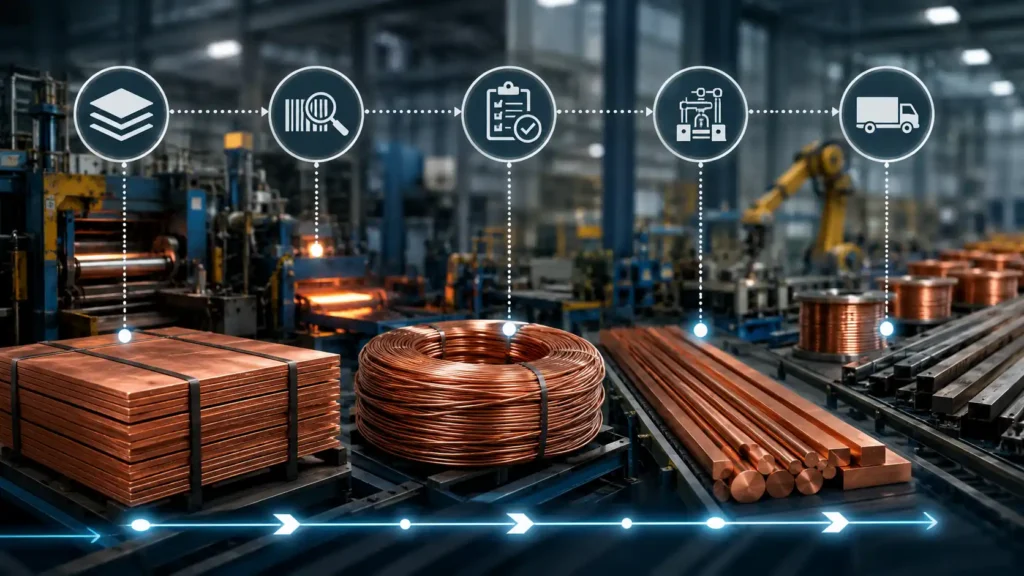
The main risk arises when the material changes format. A coil may be split or rewound; a bar may be cut; and a flat bar may be drilled, machined, or repackaged. Each operation must preserve the link to the original identification.
- Receiving: verify the reference, quantity, condition, and documentation.
- Storage: keep labels legible and prevent material from being mixed.
- Processing: record cutting, rewinding, coating, or machining operations.
- Inspection: link measurements and tests to the traceable unit.
- Shipping: transfer identification to the packaging, packing slip, and certificates.
If units from different batches are combined, the system must record the grouping and preserve every origin involved. A new reference cannot erase the previous history.
Which Documents Must Be Linked to the Material
The technical data sheet describes general characteristics; the quality certificate records data for the supplied material or batch; test reports provide measured values; and the declaration of conformity confirms compliance with defined requirements when applicable.
Traceability requires a common identifier across the material, label, purchase order, process record, certificate, and packing slip. A valid document loses value if it cannot be linked to the coil, bundle, or shipment delivered.
- Purchase specification: grade, format, tolerances, and required documents.
- Process record: operations, dates, and responsible personnel.
- Certificates and tests: associated properties and inspection results.
- Label and packing slip: identification during storage and delivery.
Quality Standards and Chain of Custody
Management system standards help structure processes, responsibilities, supplier controls, and the handling of nonconformities. However, certification of a quality management system does not automatically certify every batch of copper.
Chain-of-custody standards provide terminology and models for controlling material flows. They also do not validate by themselves a claim about origin, recycled content, or responsible production. The declared attribute requires its own criteria, evidence, and clearly defined scope.
Each project must also review product standards, contractual requirements, and customer specifications. The required level of traceability depends on the criticality of the application.
How to Respond to a Nonconformity
When a deviation occurs, the system must identify the affected unit, locate inventory and shipments, place pending material on hold, and retrieve the associated inspection records. It must then determine whether the cause was material mixing, incorrect identification, a process deviation, or inaccurate documentation.
The response may include segregation, reinspection, reprocessing, return, or customer notification. Placing too much material on hold increases costs, while placing too little on hold leaves the risk unresolved.
Traceability and Industrial Green Copper
Traceability can support attributes associated with green copper, but it does not automatically make the material sustainable. Knowing its origin alone does not prove recycled content, a lower carbon footprint, or responsible production.
Physical segregation keeps materials with a specific attribute separate from other material flows. Mass balance allows certain materials to be mixed under defined accounting rules. These two models produce different types of claims.
To substantiate recycled content, the methodology, calculation period, declared unit, and correspondence between material inputs and the final product must be defined. An environmental claim does not replace requirements for composition, properties, tolerances, or testing.
The TRAZA Method for Improving Traceability Control
- Type and scope: define the product, traceable unit, and requirements.
- Recordkeeping: assign identifiers and retain origin data.
- Association: link the material, process, inspection, and certificate.
- Controlled areas: prevent mixing and loss of identity.
- Audit and action: verify consistency and respond to deviations.
Metrics for Measuring Traceability
There is no universal benchmark. Targets must be adapted to the contract, application, and level of risk.
- Documentation completeness: deliveries accompanied by all required documents.
- Retrieval time: time required to locate certificates.
- Physical correspondence: units linked to their batch and records.
- Containment time: speed at which affected material can be placed on hold.
- Discrepancies: differences between the label, packing slip, and certificate.
Frequently Asked Questions About Copper Traceability (FAQs)
No. It facilitates access to information, but traceability depends on the data being accurate and linked to the actual product.
The new unit must remain linked to every source batch, the quantities used, and the operation that created the mixture.
Through input records, chain-of-custody rules, quantity reconciliation, and evidence linked to the declared product.
Conclusion: Traceability Means Verifiable Control
Traceability in semi-finished copper products is reliable when each physical unit can be linked to its origin, processing operations, inspections, documents, and final delivery. This continuity reduces risk, facilitates audits, and enables an accurate response to nonconformities.
In electrical and industrial projects, a reliable solution combines technical performance with documentary capability. When environmental attributes are involved, traceability must be integrated with a chain of custody and specific supporting evidence. Only then can quality, compliance, and sustainability become part of the same control system.